

Bruna Corsari
1910 is the year of the Pioneers, a fundamental year for the aerophilatelists who collect the flights of the pioneers. It is the richest year in aviation events organized in fourteen Italian cities from North to South, from spring to autumn: in Firenze, Palermo, Genova, Mantova, Ferrara, Napoli, Bologna, Verona, Parma, Vercelli, Pescara, Milano, Torino and Treviso.
We will focus on just a few, the most important ones.
The first “AVIATION SHOWS” at Campo di Marte in Florence, from March 28th to April 5th, aroused great interest and enthusiasm, despite the various accidents, but without serious damage to the pilots. Grandstands and seats were set up for over 50,000 people. The Italians were unfortunate: the brave Mario Faccioli, with his biplane, crashed the plane on test flights and the Bolognese Mario Cobianchi, also with his biplane, had a breakdown in the aircraft, even before rising.
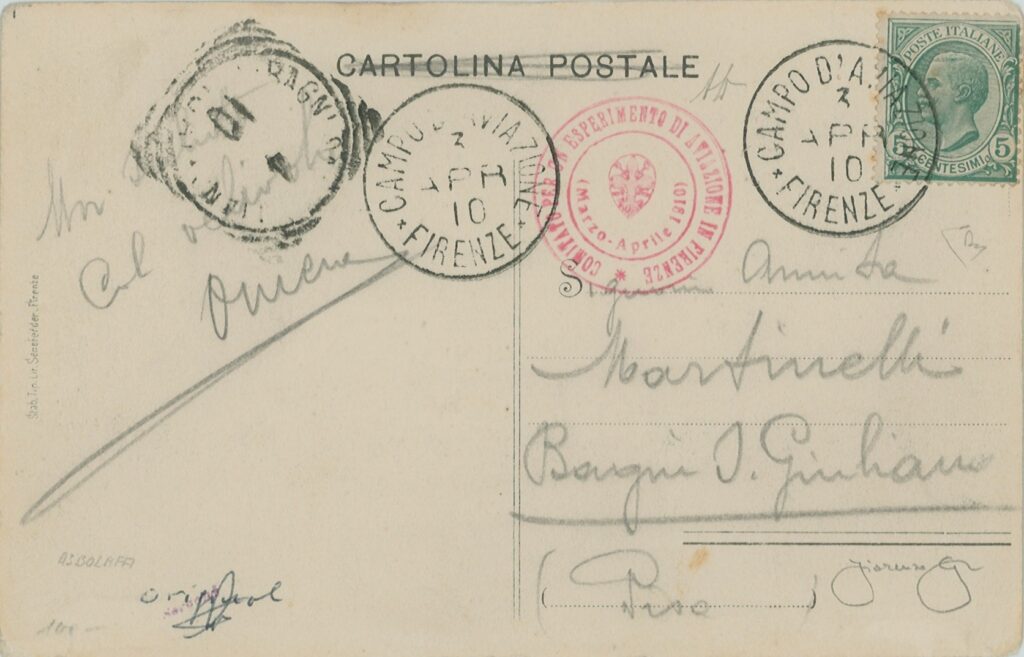
Fig.1 Recto 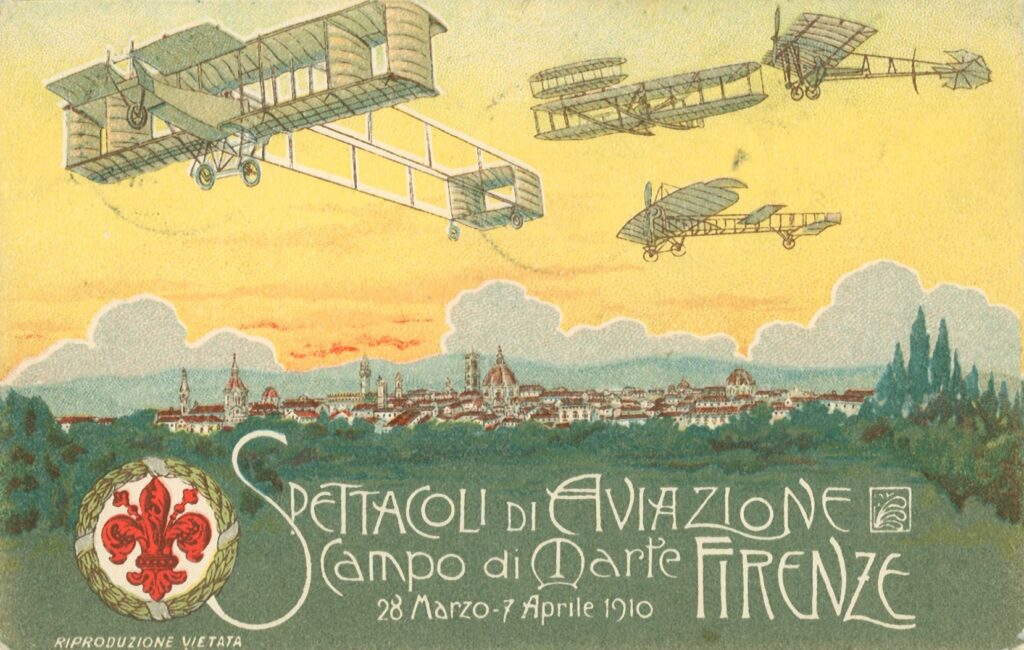
Fig.1 Verso
The novelty concerning air postal history is important. The “Regie Poste” asked the Ministry for a stamp for a first cancellation of correspondence with the wording “Air Mail”. It was the first example of an “Air Mail” stamp. From a post office, on the edge of the field, the correspondence was canceled with the words “Campo d’Aviazione – Firenze” with date in the center; but they arrived at their destination by the normal transport means.
In the following month, from May 1st to 7th, the “WEEK OF AVIATION” was held in Palermo, organized by Vincenzo Florio, an enthusiast for the future of aviation and creator of the automobile “Coppa e Targa Florio” of Sicily. Due to inclement weather the flights were reduced to a few single and incomplete days.
The only Italian competitor, defender of our colors, Clemente Ravetto, got up with his Voisin biplane from the Mondello aerodrome, making a three-minute flight applauded by visitors. On the last day of the event, forced to land due to an engine failure, he fell to the ground, but remained unharmed among the wreckage. The philatelic documentation is scarce, only a few postcards remain. The “AVIATION EXPERIMENTS” in Bologna followed, from May 22nd to May 30th. The public was numerous, despite the erratic and rainy weather that hinders the program; a waving of handkerchiefs underlined the reckless flights of the pilots. The days ended with the celebrated Olieslager Giovanni, a Belgian pilot, and with the most beautiful flight of Ten.Vivaldi Pasqua Ugolino, on a Farman biplane, which made a complete turn back to the starting point, at a height between 10 and 12 meters. Franked postcards were few (the post office had no stamps). They were regularly stamped with the words “Campo d ‘Aviazione Bologna” with date in the center.
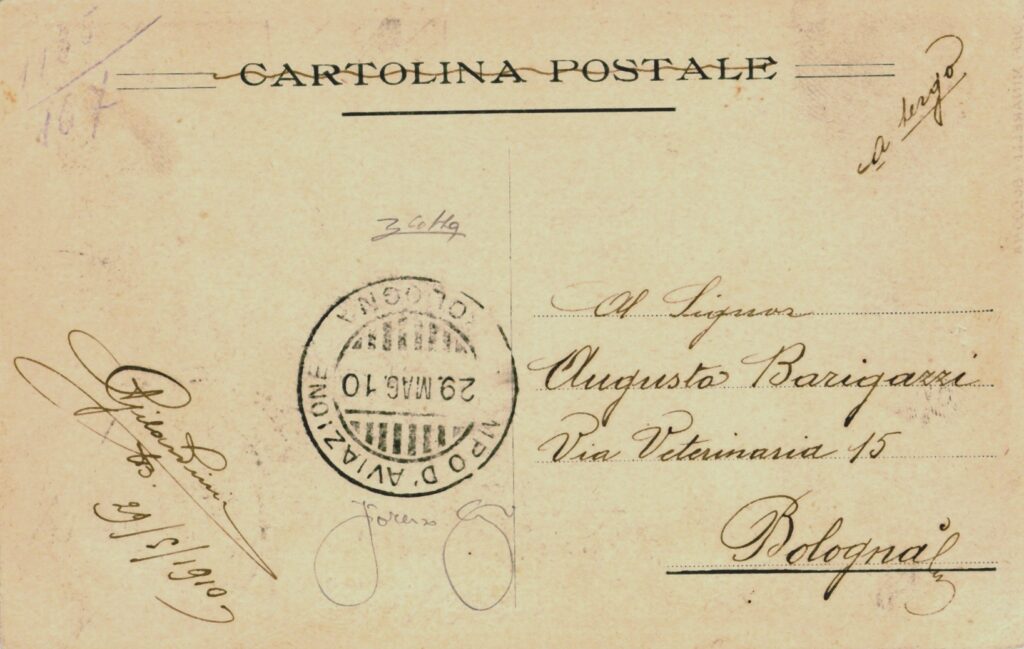
Fig.2 Recto 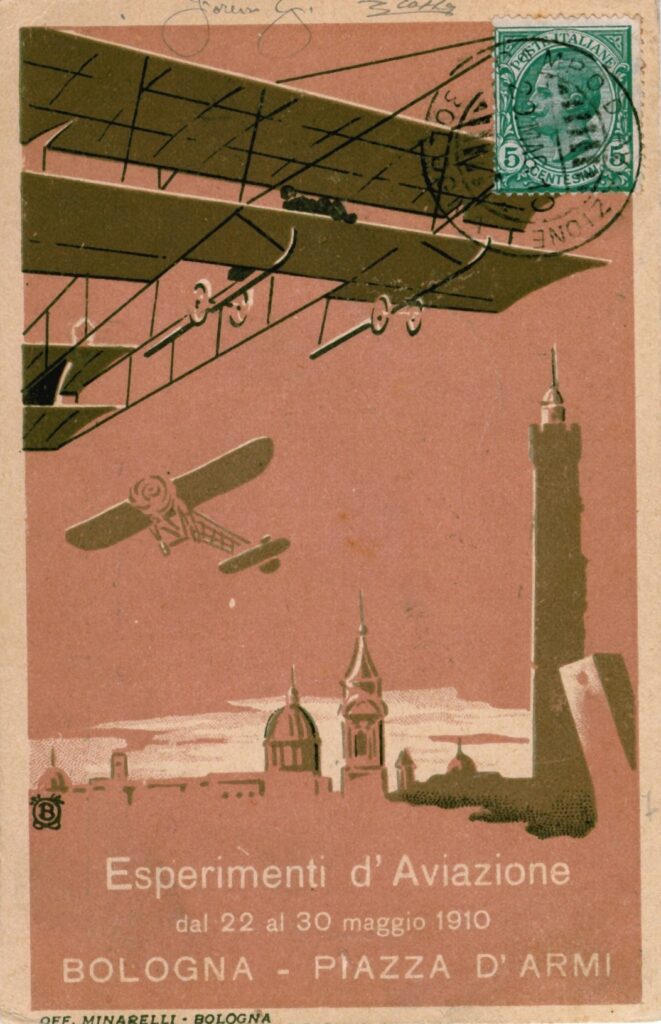
Fig.2 Verso
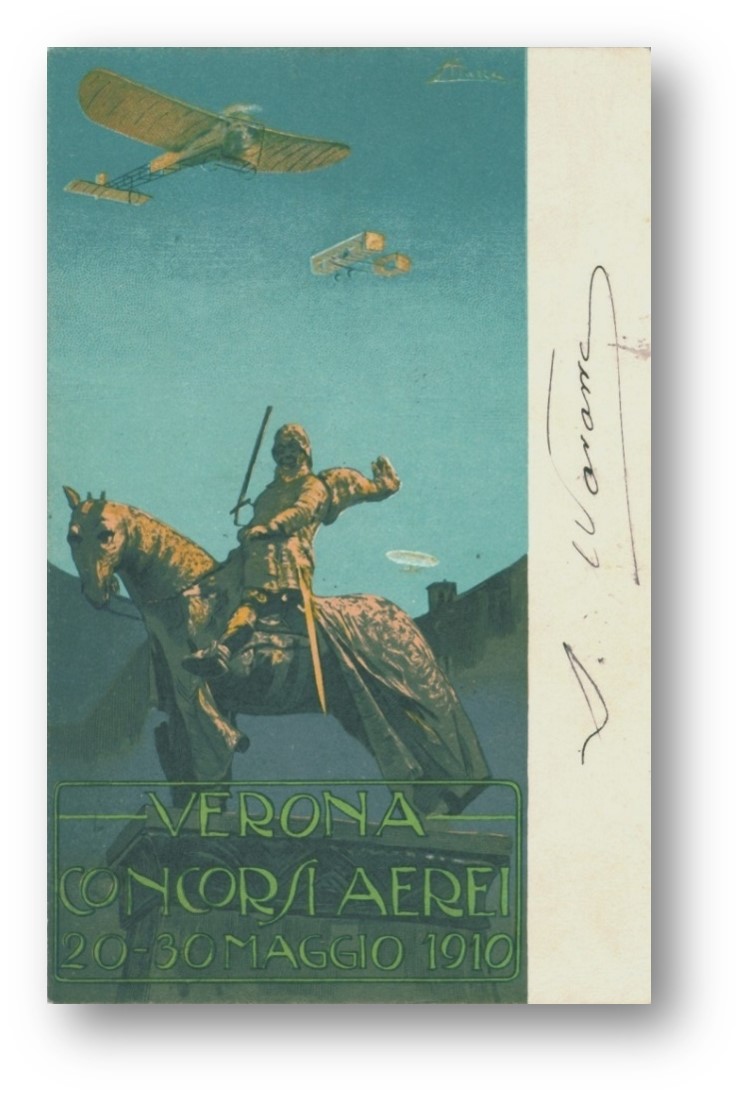
At the same time, from May 22nd to 29th, the “INTERNATIONAL AIR COMPETITIONS” in Verona were planned and held. The large terrain of the Piazza d’Armi was the airfield. The sum of the cash prizes was 200,000 lire, there were also medals, plaques and badges. The initial program had a preface by D’Annunzio. A large poster depicting the famous Colleoni monument flown over by airplanes, was prepared by Aldo Mazza and reproduced on official postcards. The week was exciting!
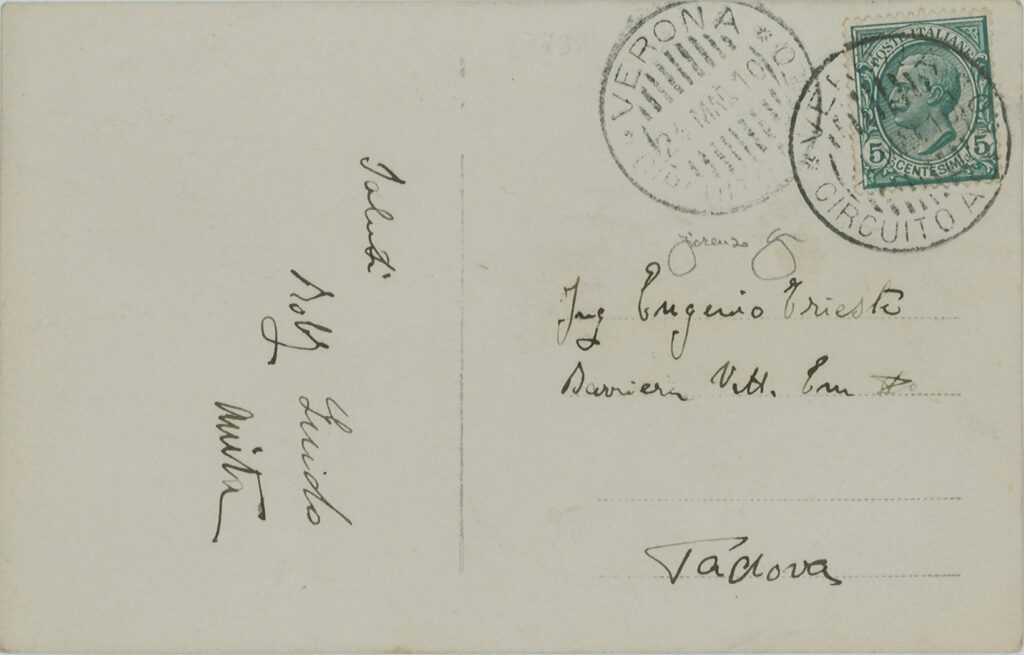
Fig.3 Recto 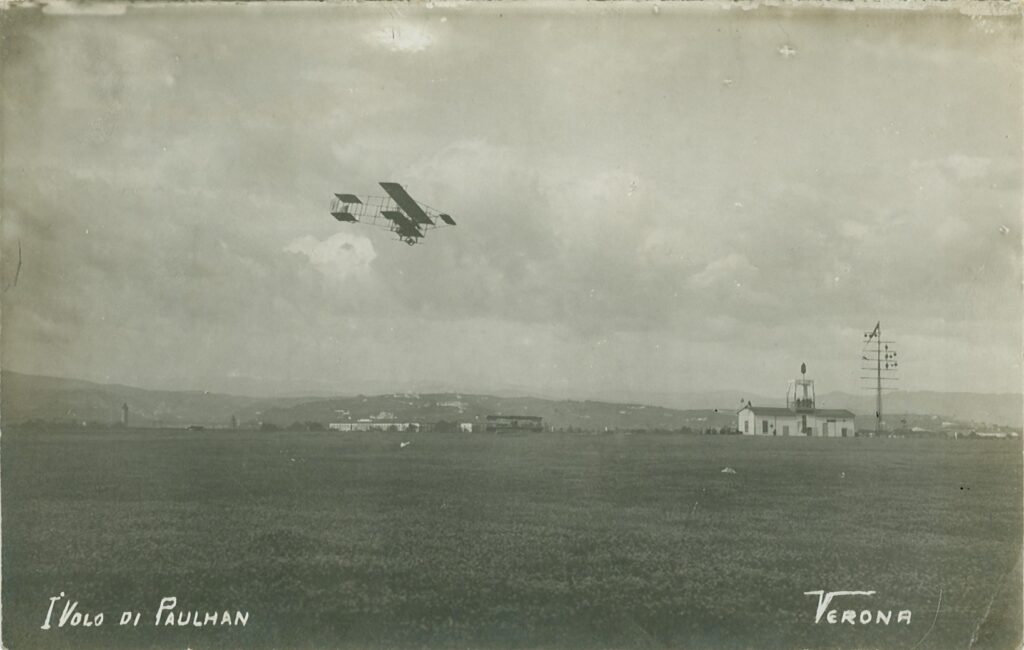
Fig.3 Verso 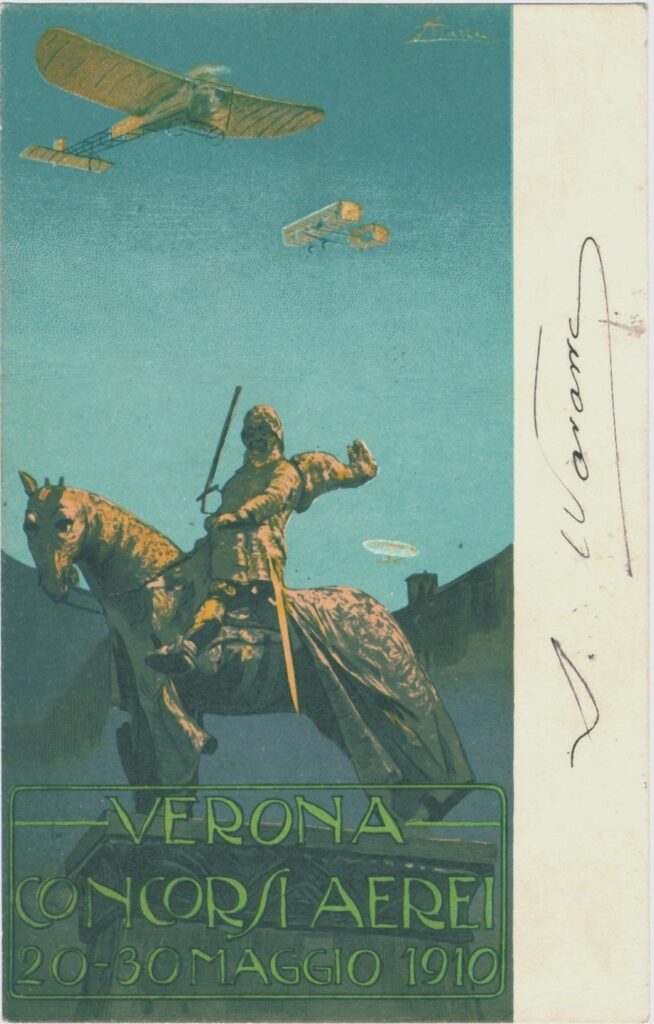
Among the nine participating aviators, the only Italian in contention was Bartolomeo Cattaneo, who with true mastery piloted his new Blériot 50 hp monoplane, beating the national height record with 194 meters, achieving the first Italian victory. In recognition he received the gold plate, coined by resolution of the sports commissioners. The French Luigi Paulhan, the Russian Michele Effimof and the Peruvian Geo Chavez stood out in the races. Also in Verona was used the postmark with the wording “Verona – Circuito aereo” with date in the center.
On the occasion of the event, Ten. Col. Cav. Enrico Milza composed a lively and pleasant poem “Ludi Veronesi”: …il piano sovrasta immenso e i colli fioriti..la folla chiassosa i ludi attende..”
The “FIRST AVIATION EXPERIMENTS” took place in Pescara from July 31st to August 7th. Gabriele D’Annunzio, returning from Brescia, expressed the desire that in the inauguration celebrations of the city’s aqueduct and port works, aviation experiments would also be included, which he promised to attend.
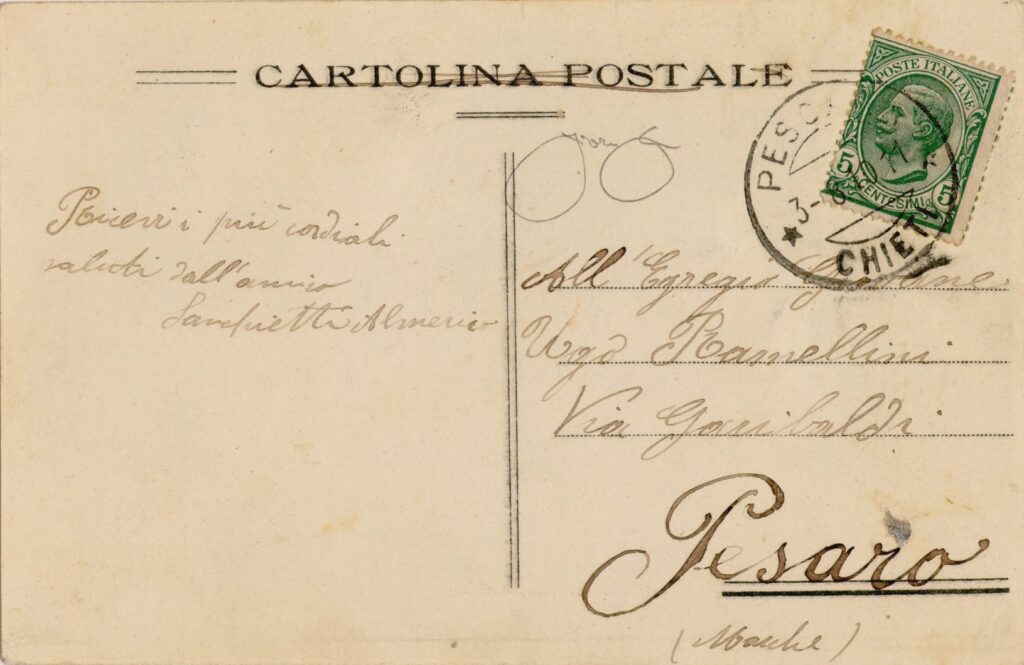
Fig.5 Recto 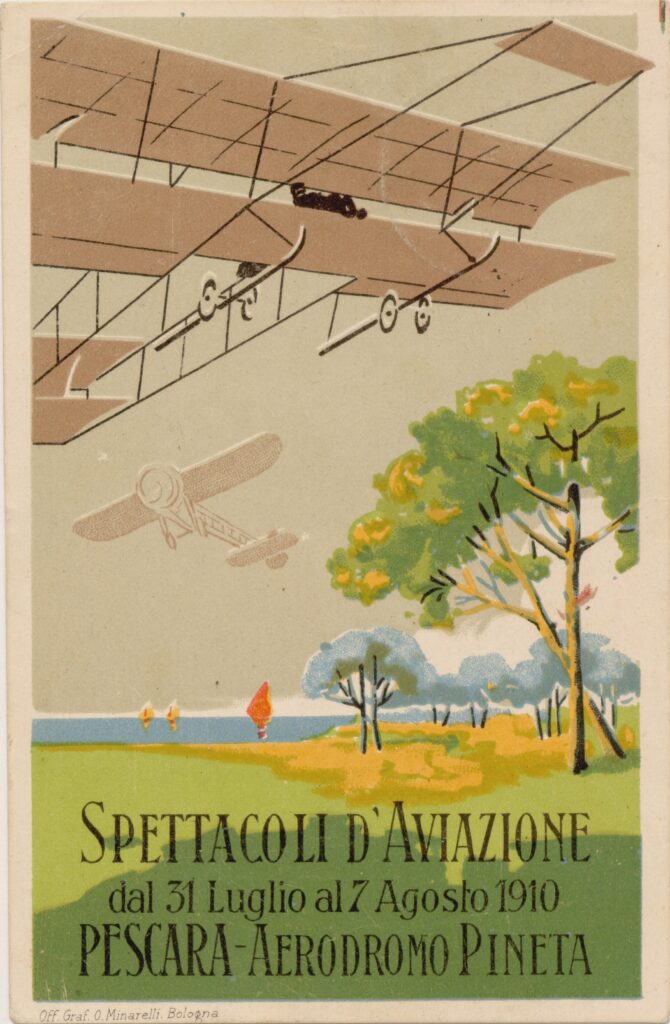
Fig.5 Verso
There were only two competing aviators: Andrea Frey with a 50 hp Gnome Sommer biplane and Renato Barrier with a 25 hp Anzani Blériot monoplane. A specimen is exhibited at the Air Force Historical Museum in Vigna di Valle on Bracciano lake. Frey rises from the aerodrome, between the sea and the pine forest, making two splendid flights. Barrier was unable to take part in the first day’s flights, busy assembling his Blériot. The second day was the most interesting: Frey among the delirium of the public, won the Coppa del Commercio (Commerce Cup) for height flights. From a philatelic point of view, there is a unique and rare piece of Air Mail from the event.
Towards the end of the month, precisely on August 20th, the sad news Ten.Vivaldi Pasqua’s death arrived, occurred during a raid towards Civitavecchia. The management of “Corriere della Sera” published on August 31th an open letter to the Hon. Sen. Cesare Mangili, President of the “Italian Aviation Society” of Milano: “Il Corriere has always contributed to promoting the development of new means of locomotion … … We wish to propose to the Italian Aviation Society the organization of a a tour of airplanes in Italy … Corriere della Sera is making the sum of 50,000 lire available to the Italian Aviation Society. ” The proposal was accepted by the Hon. with pride, but for organizational reasons the tour did not take place. The offered sum was destined to the national subscription in favour of “Flotta Aerea Nazionale”:
From September 25th to October 2nd, the “INTERNATIONAL AIR CIRCUIT” of Milano took place, the most interesting air race among those held in Italy. It was closely linked to the “FIRST AIR CROSSING OF THE ALPS” which was to take place from September 8th to 24th on the Briga-Sempione-Domodossola-Stresa-Varese-Milan route.
The organization turned out to be quite difficult for both Italy and Switzerland. The mountains were an insurmountable obstacle. It was necessary to provide a meteorological information service, the installation of telegraph and telephone lines, mountain and medical assistance.
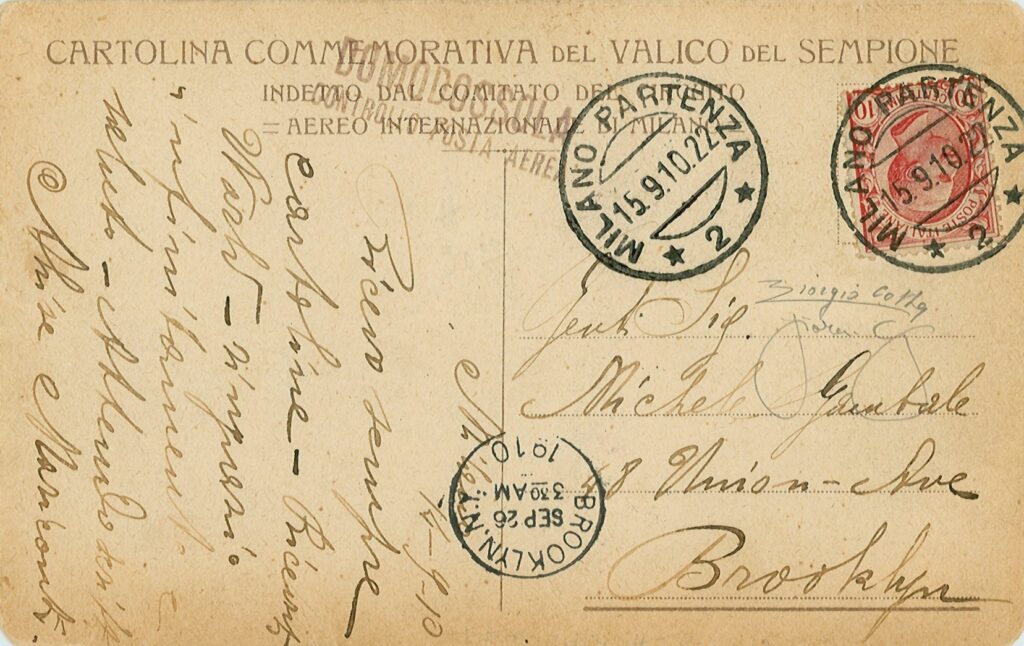
Fig.6 Recto 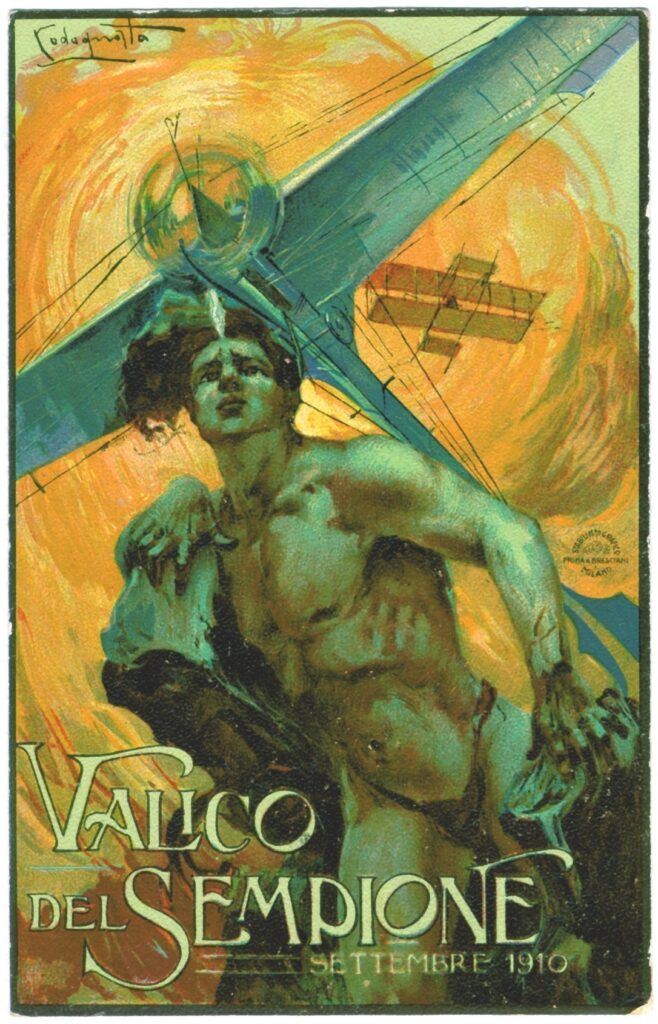
Fig.6 Verso
The Committee received seven registrations, including Geo Chavez the most qualified. Snow, wind and fog hindered the first official departure of Chavez, who after a crash landing exclaimed: “I had to flee. The invisible enemy has won me”. On September 23rd, the American Weyman took off, but landed immediately. Chavez decided to take off from the Briga camp at 13.25, passed the Simplon Pass and the terrible narrow Gondo Gorges. Violent winds put a strain on the slender canvas and wooden structures of the Blériot XI. Chavez prepares to go down to Domodossola. The people were on the grassy lawn of the plain. Success was guaranteed. He attempted to land but one wing gave way and the plane crashed to the ground. The winner was transported to the hospital for his injuries but after four days his body gave out. The news of his death moved the whole world. Chavez was a complete pilot, he loved flying, he knew deeply the secrets of the technique of flight, with determination and courage he managed to accomplish a superhuman undertaking by challenging the great white mountain. Barzini wrote: “Chavez hero for the sake of a dream” and Pascoli added: “He falls with his soul alone, always climbing. And now really he flies!”
The “Traversata delle Alpi” was followed by the “INTERNATIONAL AIR CIRCUIT” of Milano, endowed with rich prizes.
The competitors who took part were twenty-five. Many spectators had found a place at the Taliedo airfield which could hold over 100,000 people. The King of Italy attended the races together with the Count of Torino. He was a frequent visitor to the days and he experienced the thrill and joy of flying on the Farman biplane by Germano Ruggerone, known as Eros.
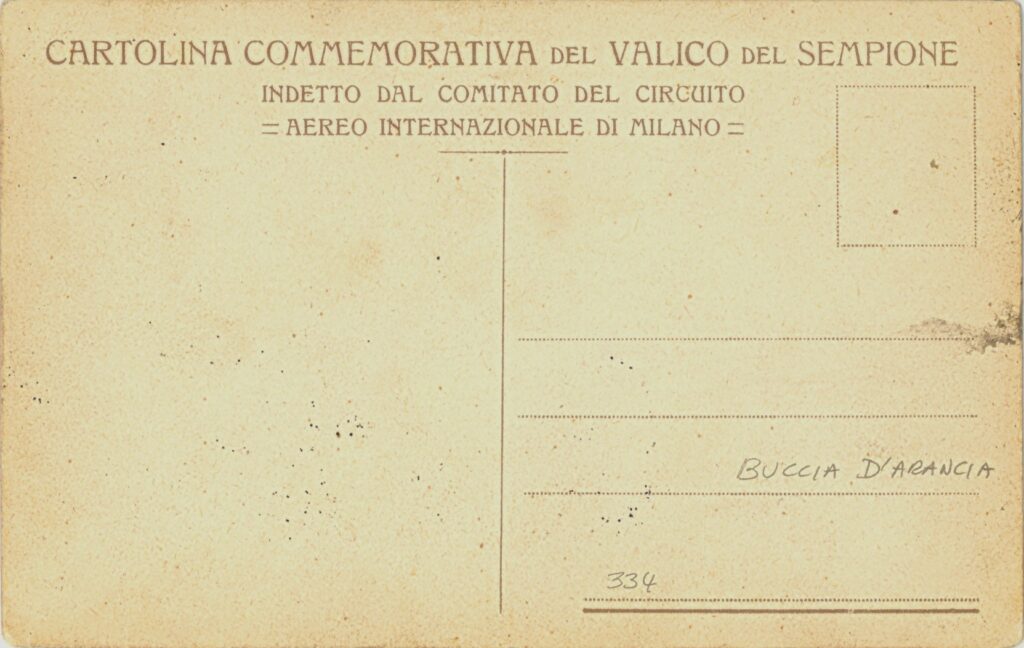
Fig.7 Recto 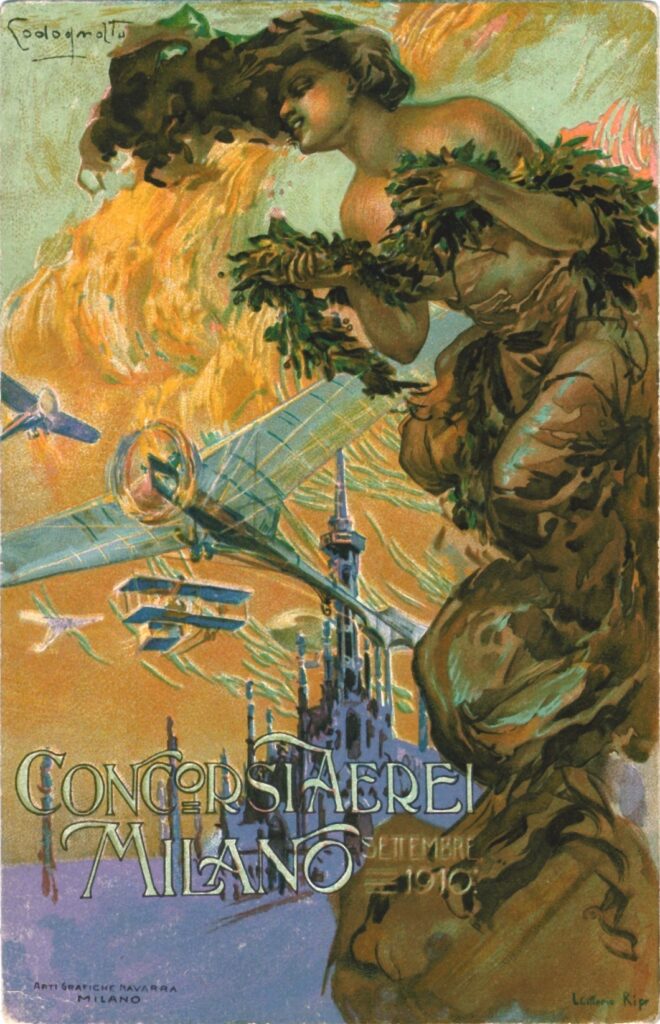
Fig.7 Verso
The inauguration of the flights took place on the morning of Sunday September 25th. But on the third day, September 27th, at the tragic news of Chavez’s death, an atmosphere of sadness descended on the field and the aviators decided to suspend the flights, but then some took off in order not to disappoint the public, carrying a black ribbon. in the air and giving up the prize. On Thursday 29th, the day of Chavez’s funeral, flights were suspended and all the airmen went to Domodossola to attend the funeral of the late and unforgettable friend and companion. Eventually the winners of the Circuit were: Cattaneo on Blériot grand prix of the speed race (100 km at 88.575 km / h) and momentum award (40 m), he was proclaimed national champion of speed and distance without stop (102,500 km ); Cagno on Farman: passenger award (with 2 passengers 10 km in 11 minutes and 13 seconds) receiving a silver cup from the Ministry of Post; the French Legagneux on Bleriot: grand prix of height (2,050 meters); Fischer on Farman: grand prix of the totalization of the distance (with Km 1,222.50).
Some official and private postcards were published, very rare those canceled with the special stamp “Milano Campo di Aviazione”. We can say that the first year of aviation in Italy ended in Torino from November 5th to 13rd, at the Ippodromo delle Corse in Mirafiori, a few kilometers from the city. Ruggerone was the first to fly over the city with the Farman biplane. The people, amazed, applauded from the windows and balconies and left the houses. The pilot made very bold turns over the stands between the applause and the ovation of the audience.
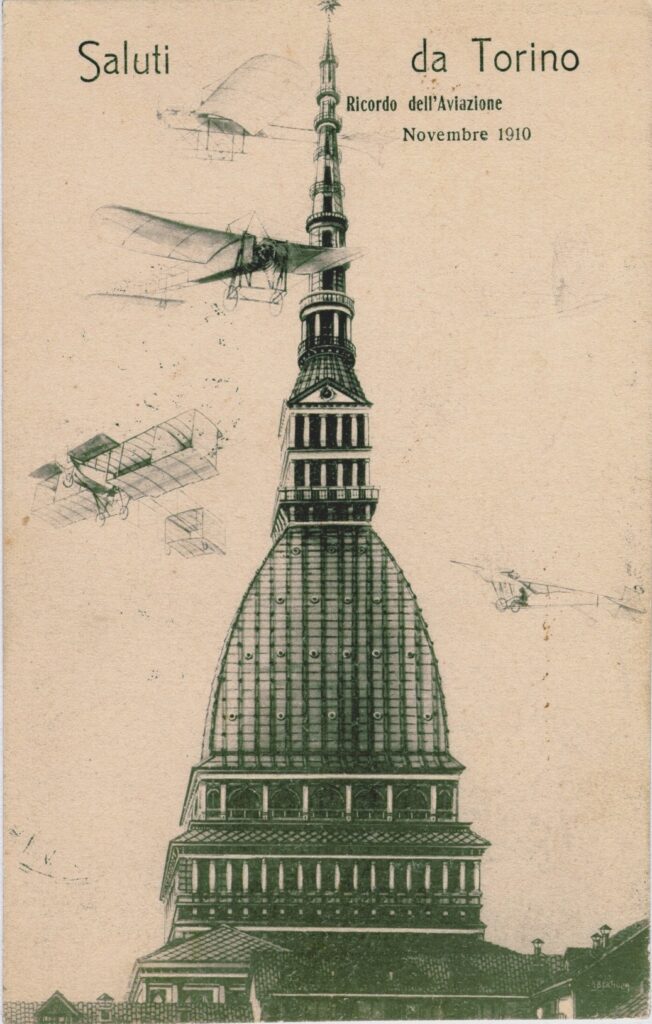
Fig.8
Flying cars were depicted on the postcards of the event and the first aerial photographs were taken during the races on November 10th.
The airplane aroused great hopes for man, capable of plowing the ways of the sky, became a symbol of the ideals of progress and freedom.