


Italian Association
of Aerophilately
Aerophily and Aeropostal History
Italian Association
of Aerophilately
Aerophily and Aeropostal History
Italian Association
of Aerophilately
Aerophily and Aeropostal History
Italian Association
of Aerophilately
Aerophily and Aeropostal History
AIDA, “Italian Association of Aerophilately”, was founded in 1958 by a group of airmail collectors with the aim of increasing and promoting air mail study in all its forms, sectors or specialization. By following in the footsteps of founders, the members who succeeded until today, have never missed to reach the original goals. Organizing of “Day of Aerophilately” and publishing of magazine “AIDA Flash” accompained its journey up to present day.
The latest from Italy and abroad...

AVIOCOM 100 – TORINO 2026
GIDRO D’ITALIA 2026
AVIOCOM 100 – TUIN 2026

FISA CONGRESS 2026

FIFTH EDITION OF FLY FUTURE – 2026

Best wishes to all members
AIDAFlash
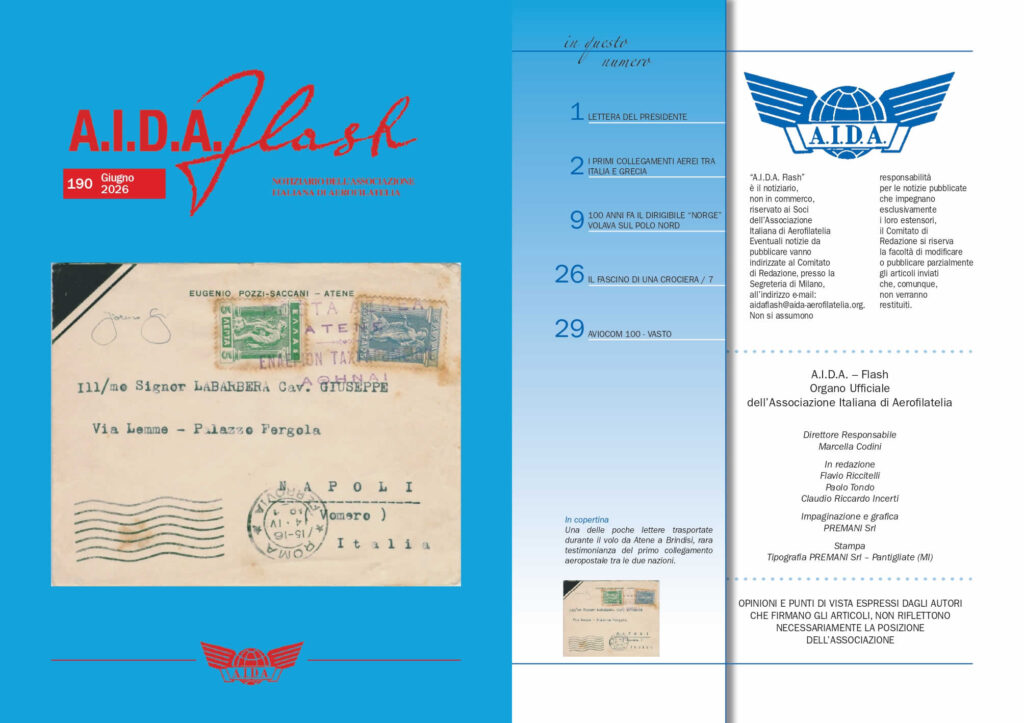
Index
01 – President’s letter
02 – The first air links between Italy and Greece
09 – 100 years ago, the airship “Norge” flew over the North Pole
26 – The allure of a cruise / 7
29 – AVIOCOM 100 – Vasto
President’s Letter
Dear Members,
as you will have seen from the various messages sent and updates published on our website, the AVIOCOM 100 initiative is proceeding at full speed. It is now landing in Vasto for the national exhibition, where we will also have the opportunity to meet during our 52nd Aerophilately Day.
You can read full details about this event later in the magazine.
I am also very pleased to highlight the updates we have made to the website’s homepage to make it more attractive and user-friendly, featuring news that is easier to read; for this, I thank our tireless Secretary.
In this issue, you will find fascinating articles, such as a unique analysis…
(AIDAFlash n.190 – June 2026)
I Quaderni di A.I.D.A.
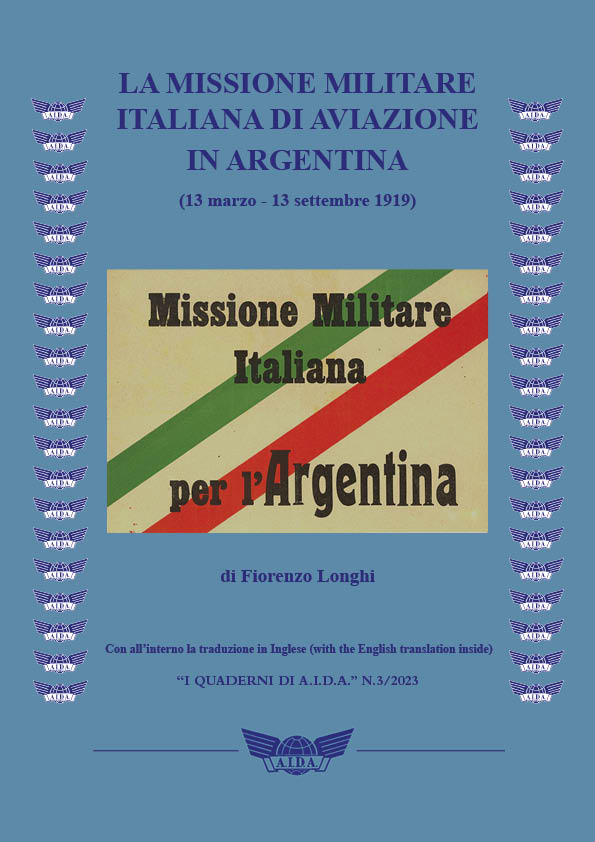
The editorial series of the Italian Aerophilately Association continues, and this year, through the “Quaderni di AIDA” (AIDA Notebooks), it reaches its third publication.
This work is a true gem, authored by our President, Fiorenzo Longhi, who generously decided to share an unpublished piece that recounts the “Italian Military Aviation Mission in Argentina.”
The project originated from a promise made to Rosetta Locatelli, sister of the pilot Antonio, back in 1975. Thanks to the material provided by the Locatelli family and his tireless research, Fiorenzo Longhi managed to meticulously reconstruct the chronicles of the Italian aviators’ exploits during the Mission in Argentina in 1919, with particular focus on historical, postal, and philatelic aspects.
To further enrich the volume, a complete translation of the text into English is also provided.
The foreword by our President is available below for reading.


“Once you have experienced the thrill of flight, when you are back down to earth, you will continue to look at the sky.” (Leonardo da Vinci)
“I hadn't really lived until now!… It is in the air that you feel the glory of being a man and conquering the elements. There is an exquisite fluidity of movement and the joy of gliding in space ”. (Gabriele d'Annunzio)
“Woe to you to look out of the cabin towards the surface of the water. Woe to seek the horizon. The slightest indecision, the moment of uncertainty, the imponderable error fruit of blind instinct, means the sure loss of the plane and of life. Forward, forward straight into the dark. " From “Stormi in volo sull'Oceano”, Italo Balbo.
“I noticed some concern around me. But I was firmly determined. I would rather have left my wings on a cornering pylon, rather than suffer the setback of a defeat. " (Mario De Bernardi) From “An Eagle in the sky”, Giorgio Evangelisti.
“I am highly confident in success, but since there are always imponderables, which escape the most diligent control, it cannot be absolutely excluded that, after my departure from Floyd Bennet's camp, nothing more is known about me. And since in this case I could be accused of incapacity or extravagance, I count on the high testimony of your competent examination made in my preparation to defend my memory from any posthumous accusations”. From a letter from Francesco De Pinedo sent to Admiral Romeo Bernotti on September 1st 1933, before the departure of the tragic flight from New York to Baghdad.
"We haven't gotten off the airplane yet and Count Labia is already asking us an unexpected question:" Do you have a tuxedo? " The Count did not know that Mazzotti had denonimated our 12,000 km raid with two shirts! " Francis Lombardi, upon his arrival in Capetown during the circumnavigation of Africa carried out with Rasini and Mazzotti between October 28th, 1930 and January 9th, 1931; From "Francis Lombardi, Three Raids of 1930", Arma Aeronautica Association.
“We are falling, Sabelli. What should I do?" "Lighten the plane." Geo Pond to Cesare Sabelli on May 5, 1934, two hours before touching Irish soil in an attempt to get to Rome from New York; (Cesare Sabelli) From “To Rome with Sabelli”, FAA Aviation News.
“Once you have experienced the thrill of flight, when you are back down to earth, you will continue to look at the sky.” (Leonardo da Vinci)
"When you walk the earth after flying, you will look at the sky because you have been there and you will want to return there" (Leonardo da Vinci)


“When, a few years ago, I joined the Aéropostale, I had the impression of setting foot in a convent. The first day I had to put up with a sermon on the mail to be delivered, on the sacrifices to be dedicated to it, on the need, whatever the cost, to reach the goal even through the storm, and finally on the penalties I would have to pay in case of a fiasco. I learned that a delay, whatever it was, was in itself dishonoring. " From "Airline Pilot", Antoine de Saint-Exupéry.
“It is tiring to fly on the water. I go up to thirty meters and scan the horizon in search of some sign of life. There are still some fishing boats in sight. When I am else I can sit comfortably by handling the bar and pedal unit lightly, just to keep the compass needle well centered. When you are low you have to hold the controls more skillfully and pay attention to the distance between the wheels and the water " From "Spirit of St. Louis": the third hour, on the Atlantic, Charles A. Lindbergh.
“The mystic of the courier was born, valid in and of itself, and none of us, at the moment of take-off, ever worried about it. The intensity that he gave to our life, it alone mattered, it alone had a meaning. " From "Airline Pilot", Antoine de Saint-Exupéry.
“Some comrades, and among them Mermoz, laid the foundations of the French line from Casablanca to Dakar across the unsubmissive Sahara. ... For the opening of the American line, it fell to Mermoz, always a leading man, the task of studying the stretch from Buenos Aires to Santiago and, like a bridge over the Sahara, build a bridge over the Andes. ... In these duels Mermoz engaged without knowing anything about the adversary, without knowing whether from such struggles one still emerges alive. Mermoz tempted for others. ... Having explored the Andes well, having perfected the technique of the crossings, Mermoz entrusted that stretch to his companion Guillaumet and went off to explore the night. ... After taming the night properly, Mermoz tried the ocean. ... Mermoz had thus cleared sand, mountains, night and sea. And in sands, mountains, night and sea had been shipwrecked several times. He had returned, each time, only to leave. ... Finally, after twelve years of work, finding himself once more flying over the South Atlantic, he signaled with a short message that he removed the contact to the right rear engine. Then there was silence ”. From "Land of men", in the chapter "The Companions", Antoine de Saint-Exupéry.
The tragedy of the “Croix du Sud” seaplane is consummated after Mermoz is forced to land due to some problems with the right rear engine. The fault is quickly identified, but in the absence of spare parts, only a simple cleaning of the engine is carried out, which appears to be satisfactory. The seaplane then resumes flight, communicating its position regularly. But at 10.47, a quarter of the way through, a last message is received in Dakar: “avons coupé moteur arrière droit ...” then, nothing more. (Jean Mermoz)
“He spread confidence like a lamp that spreads light, that companion who would later beat the primacy of the postal crossings of the Andes mountain range and the South Atlantic”. It is he who unfolds the cards and shows the obstacles or signs of human presence, in order to make the country that is flying over it a friend and that make the pilot "accustomed" to the Line, which teaches to create bonds with it. And this is also because pilots are recommended to always fly under the clouds, following the reliefs of the terrain across the border. From "Land of men", in the chapter "The Companions", Antoine de Saint-Exupéry.
“Yes, aviation has great possibilities, but how fragile are its wings! When all goes well we can roam the heavens like gods, letting the earth rotate at our feet, participating in life below us, or, if we prefer, estranging ourselves from it. But the slightest mistake is enough to make us fall and the precipice is often almost invisible: a microscopic mechanical defect, a few grains of ice in a Venturi tube, the lack of an hour of sleep. " From "Spirit of St. Louis", Charles A. Lindbergh.
“A strip of land, about fifteen kilometers wide, affects the horizon: Cape Hague. The French coast! It comes like an outstretched arm to meet me, bright in the sunset light. From this coast, thirteen days ago, Nungesser and Colì left for the ocean flight to the west. They had taken off from Le Bourget where I will land in a moment. How far have they gone? Why are they lost? " From "Spirit of St. Louis": the thirty-second hour, on the English Channel, Charles A. Lindbergh.
“The sun almost touches the horizon when I look further towards Cherbourg which embraces its small bay. Here is France, six hundred meters below my wing. After 5,450 kilometers of flight, I am on the destination country. I completed the first direct flight between the two continents of America and Europe. There will be no second night in the clouds. There is no need to go back to the water. Whatever happens now, I will land in France. There are only 320 kilometers to Paris, half of which I will travel in the light of dusk. " From "Spirit of St. Louis": the thirty-second hour, on the English Channel, Charles A. Lindbergh.
“I had just turned off the engine when the first ones reached my cabin. Within seconds, dozens of enthusiastic faces appeared in my open windows. I could hear my name shouted from all over in a strange accent… Hear the Spirit of St. Louis tremble under the pressure of the crowd. I heard the crash of wood behind me… Then there was a second crash, and a souvenir had begun. I had to stop the plane at any cost before the damage became irreparable. " From "Spirit of St. Louis". Epilogue, Charles A. Lindbergh.
45,000 kilometers aboard a hot air balloon: the last great adventure of the 20th century. The Breitling Orbiter 3 left Switzerland on March 1, 1999 and reached Egypt 19 days later. From "The Last Great Adventure", Bertrand Piccard and Brian Jones.
The flight around the world of Bertrand Piccard and Brian Jones was not only a success of technology but also, and above all, a triumph of the human spirit: “We took off as pilots, we flew as friends, we landed as brothers”. From "The Last Great Adventure", Bertrand Piccard and Brian Jones.
“Inventing an airplane is nothing. Building one is something. Flying is everything”. (Otto Lilienthal)
No bird flies as soon as it is born, but the moment comes when the call of the air is stronger than the fear of falling and then life teaches it to spread its wings. (Luis Sepúlveda)
“It was a 12 second flight, uncertain, swaying and wobbly… but it was finally a real flight and not just a glide”. (Orville Wright, referring to his first flight on December 17, 1903)
“The magic of the craft has opened for me a world in which, I shall confront within two hours, the black dragons and the crowned crests of a coma of blue lightnings, and when night has fallen, I, freed, shall read my course in the stars”. (Antoine de Saint-Exupéry)
“Flying may not be all fun and games, but the fun itself is worth the price”. (Amelia Earhart)
“The flight gave us the eyes of birds, a precious point of view to observe so much world all together and the havoc we are doing with it”. (Le Corbusier)
“The forces of nature cannot be eliminated but they can be balanced against each other”. (Conte Ferdinand von Zeppelin)
“The plane is tragically inadequate for transoceanic services”. (Hugo Eckner)