

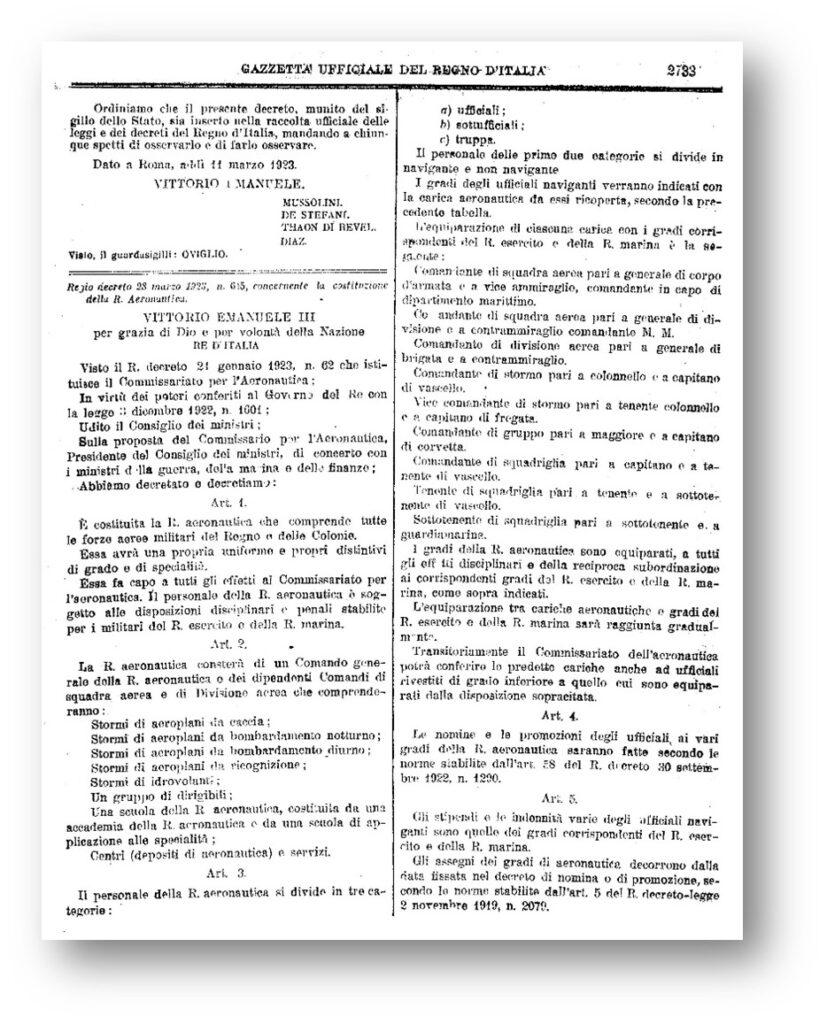
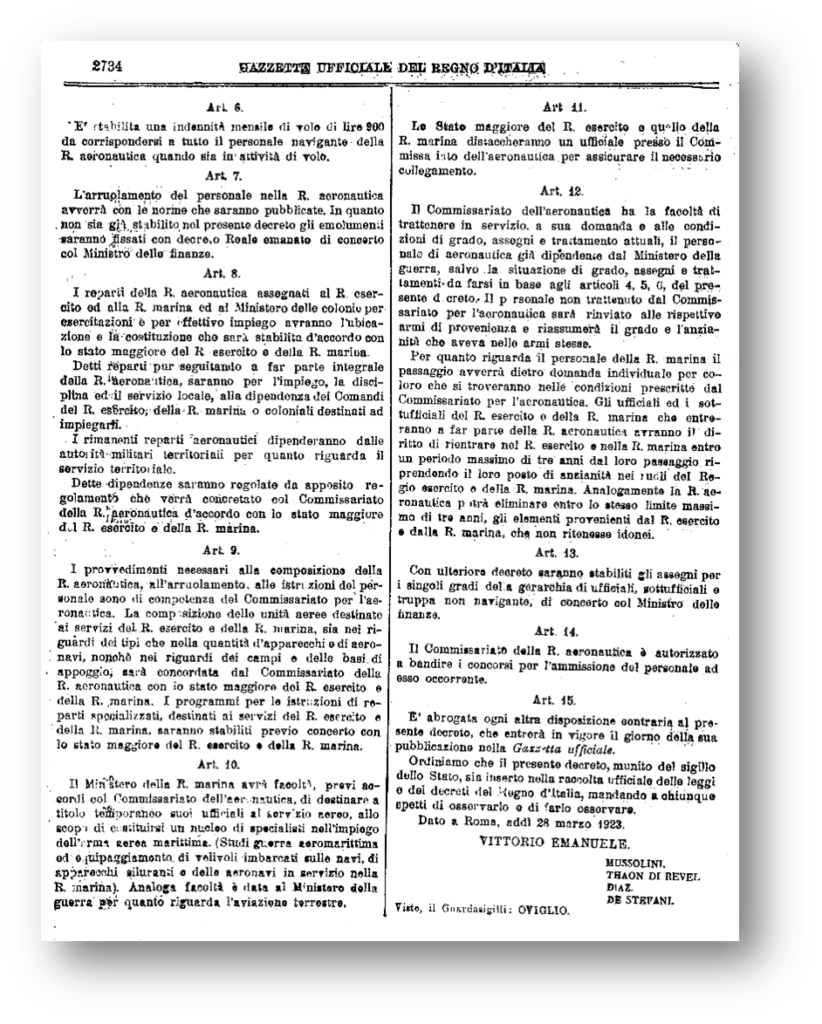
After the establishment, on 24 January 1923, of an Aeronautical Commissariat, on 28 March 1923, with Royal Decree 645, the Regia Aeronautica was born. All the military air forces of the Kingdom and the Army and Navy colonies were entrusted to it.
The men of the Regia Aeronautica played a leading role in promoting aviation in Italy, carrying out feats that have become famous all over the world and which have remained in the collective imagination of our country, with a memory still kept alive today.
The foreign policy of the fascist regime relied heavily on the promotional power of this new weapon, which was engaged in the 1935-1936 war in Ethiopia and, from 1936 to 1939, in the Spanish civil war where the Aviazione Legionaria was active. Subsequently, from 1940 to 1943, he took part in the Second World War during which, following the armistice of Cassibile announced on 8 September 1943, his men were divided between the Co-Belligerent Air Force, loyal to the Southern Kingdom, and the Aeronautica Nazionale Repubblicana, the armed force of Benito Mussolini’s Italian Social Republic. Following the birth of the Italian Republic, the Regia Aeronautica changed its name to Aeronautica Militare, but continuing in the footsteps traced by its predecessors.
For greater detail on the events that have accompanied the development of the Italian Air Force, along the hundred years since its establishment, please refer to the in-depth study carried out by Fiorenzo Longhi, which will be published in the next three issues of the magazine. It is enough for us here to dwell on the events that accompanied the delivery of the flag and, above all, on the meaning of the Air Force coat of arms, which stands out in the center of it
On 31 October 1923 about 300 airplanes and seaplanes gathered at the Rome-Centocelle airport, and on the afternoon of 4 November (fifth anniversary of the end of the First World War), the War Flag was delivered. It was the same flag granted to the Royal Army three years earlier and decorated with the Silver Medal of Military Valor, in recognition of the behavior of the Royal Army’s aeronautical departments during the First World War.
The Flag is still kept in the Palazzo Aeronautica Militare, inside the Office of the Chief of Staff of the Air Force – Sala delle Constellazioni – and is used on the occasion of solemn military and civil ceremonies during which it is an integral part of the deployment.
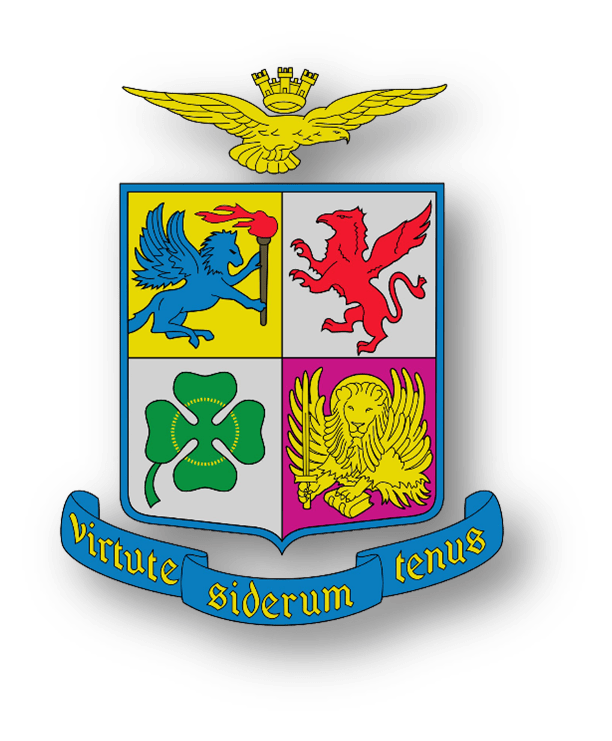
The Air Force coat of arms, surmounted by the turreted eagle, symbol of military pilots, contains the badges of four squadrons which, in the 1st World War, stood out for their skill, courage and heroism. The emblem is accompanied by the scroll with the motto “Virtute Siderum Tenus” – with value towards the stars – which summarizes the courage, skill and sacrifice of all Italian aviators. So let’s move on to the meaning of the four badges.
The winged chimeric quadruped with torch (top left), with the front part of a lion and the rear part of a horse, depicts the badge of the “X Farman Squadron”, established on 1 April 1913. During the 1st World War this unit took it takes part in numerous war operations of reconnaissance and light bombing. Subsequently called “27a Squadriglia Aeroplani” it performed over 900 war flights during the First World War.
The “Grifo Rampante” (upper right) represents the insignia of the “91ª Squadriglia da Caccia”. Known as the “Squadriglia degli assi”, it had among its ranks heroes such as Francesco Baracca, Pier Ruggero Piccio, Fulco Ruffo di Calabria and Ferruccio Ranza.
The “Cloverleaf” (bottom left) reproduces the symbol of the “10ª Squadriglia da bombardamento Caproni”, which was also employed in audacious warfare during the Great War.
The famous “Leone di San Marco” (bottom right) was adopted as an emblem by the “87ª Squadriglia Aeroplani”, renamed “La Serenissima” in homage to the city of Venice. The epic flight over Vienna under the command of D’Annunzio belongs to this squadron.