

Umberto Cavallaro
Although eminent Italian scientists such as Gen. Crocco and Riccardo Corelli had done in-depth studies on innovative fuels since the mid-thirties, interest in Italy never went beyond combustion chamber tests and no rocket was produced in our country in those years. Until the end of the 1950s, Italy had essentially been watching. All the mail-rocket launches carried out up to then in our Peninsula were operated by foreigners: the “Express Rocket Mail Experiment” on October 30, 1934 in Trieste was organized by the German Gerhard Zucker. Those of San Remo-Bordighera in 1947 were led by Dutchman AJ De Brujin. The two then in the following years had repeated several experimental launches in Sanremo and Varazze.
Immediately after the International Geophysical Year of 1957-58, a new course began in Italy. In 1959 the CRA (Aerospace Research Center) was established at the University of Rome. In 1962 NASA and CRA signed the agreement establishing the San Marco Program.
The following year came the first realization of an all-Italian missile by the Missile Transport Company which on 28 September 1963 successfully launched the “Grillo” from the Air Force shooting range in Furbara, near Rome. It was not only the first Italian missile, but also the first steam rocket in history.
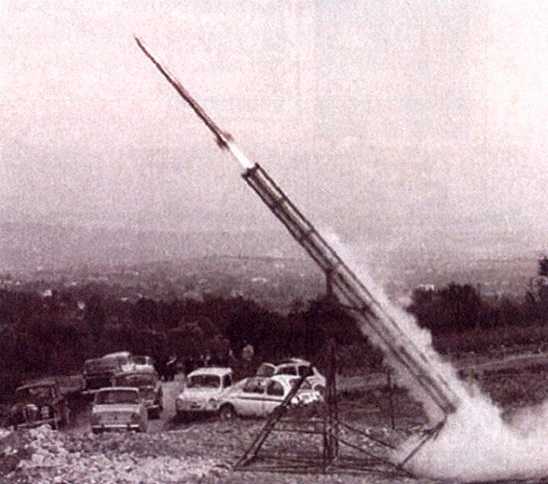
The search for a hot water missile had begun in Nazi Germany and continued, without much success, in the United States immediately after the Second World War. A rocket capable of running on cheap fuel was of great interest to the future of postal communications.
But the systems tested until then were not able to bring the water contained in the rocket’s tank to conditions of temperature and pressure such as to give the missile a sufficient initial acceleration to make it start. The best result obtained up to then was 270 ° C obtained in two hours, with 50 atmospheres of pressure.
The Trieste-based Glauco Partel, Captain of the Navy and rocket scientist, had studied the problem for years in Rome, in collaboration with two Roman engineers, Paolo Laurenzio of SISPRE and the chemical engineering expert Furio Diamantini, who had developed a mysterious propellant mixture that could generate a strong propulsive thrust: the chemical substance coming into contact with the 10 liters of water contained in the tank of the Grillo was able to vaporize it almost instantly bringing, in a fraction of a second, the water temperature to 350 ° C with the pressure at 130 atmospheres and thus creating the “miraculous” economical fuel that everyone was looking for.
The inaugural flight of Grillo, a rocket just over two meters long and 14 centimeters in diameter, carried a “payload” of 2.5 kilos, made up of 2600 lightweight small envelopes (73 x 110 mm) which had prepared AM Luisi, the Head of the Philatelic Department of the STM (Missile Transport Company).
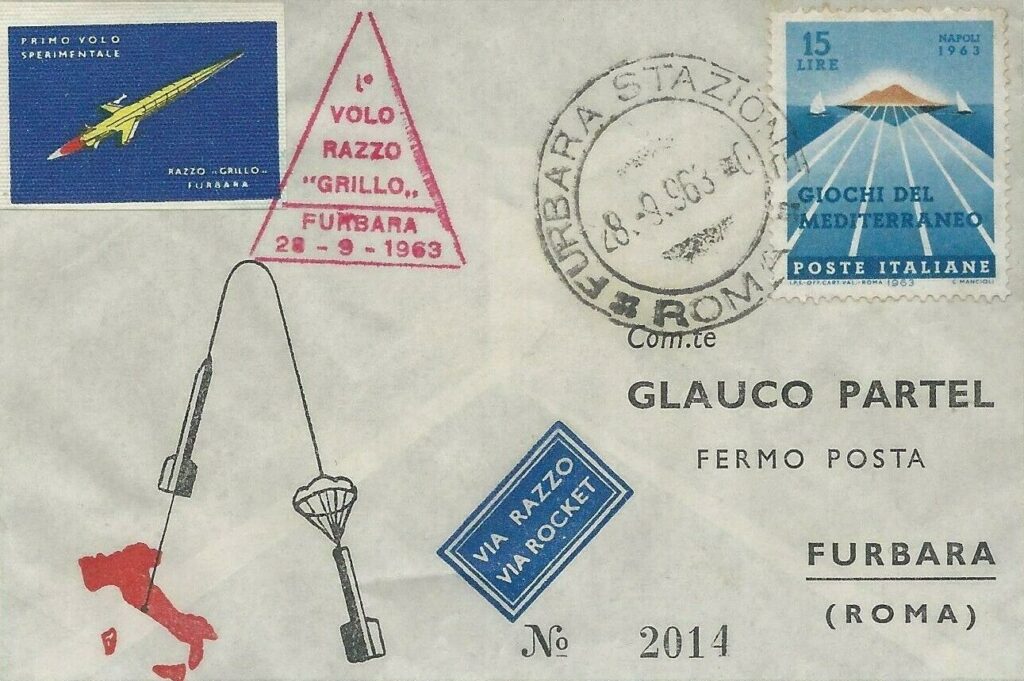
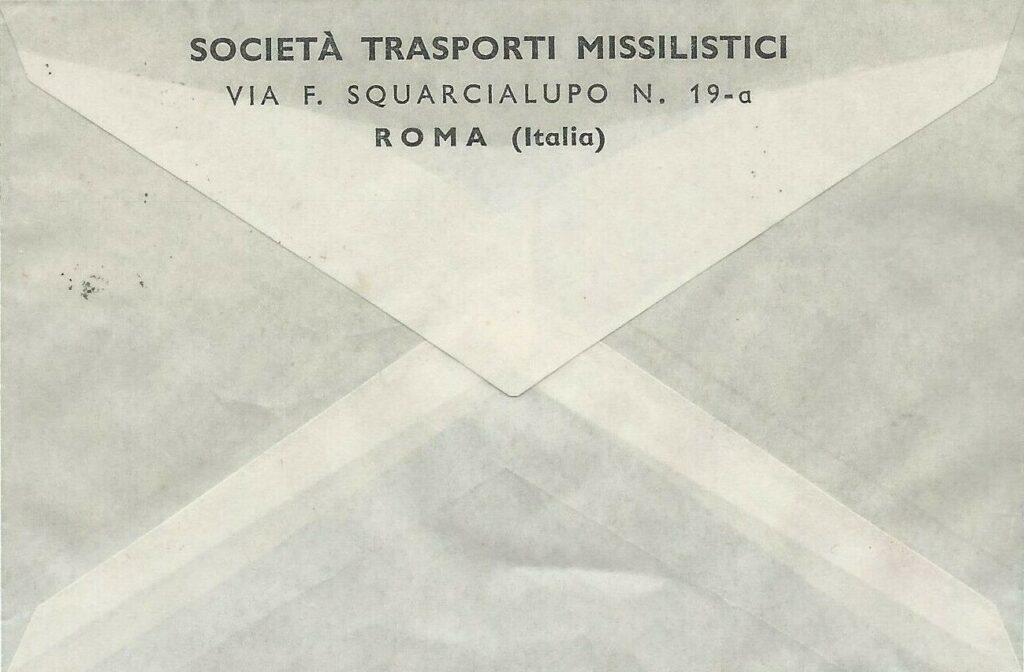
The envelopes were recovered and taken to the post office in Furbara-Stazione (Rome) where they were canceled and forwarded to the recipient. The envelopes, illustrated with a cartoon depicting Grillo in flight, were franked with a 15 lire stamp, and bore a blue “Via rocket” label, an erinnophile prepared especially for this launch, and a red triangular stamp with the words « the “Grillo” rocket flight, Furbara 09/28/1963 ».
The launch was a real success and was also watched with interest abroad, so much so that the Americans, thinking of promising applications, expressed their intention to purchase the license to produce the rocket in the United States.
A new experimental demonstration flight was organized 18 months later, in the spring of 1965 in England, during the lnternational Nuclear Conference. Grillo was launched on April 5, 1965 from the hills of Brighton, reaching a distance of one kilometer and a height of 300 meters, with a mail load of 1600 envelopes and 12 copies of the Daily Mirror which at the end of the flight were recovered intact, as proof the goodness of the carrier conceived for future postal uses. The idea was to use this means for the postal connection with the islands or with isolated areas.
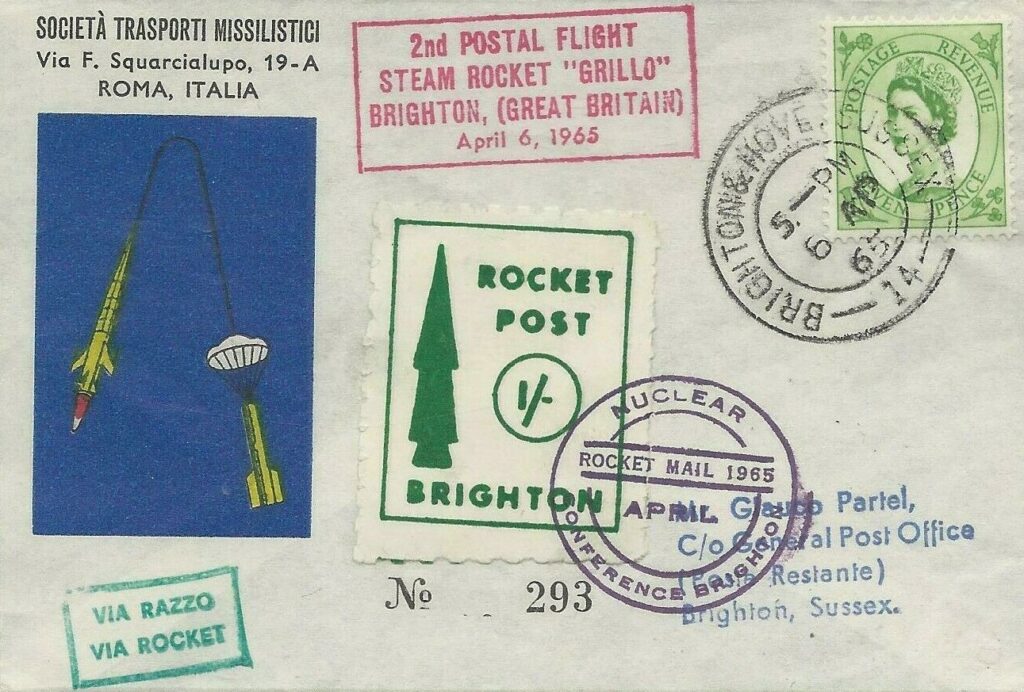
Another smaller version of the rocket, designed to be used as a sounding rocket for meteorological purposes, was launched in the Benevento demonstration flight, on 9 October of the same year, reaching a height of 1100 meters and attracting attention and interest of the Air Force. The emerging American interests in European technologies that could have promising commercial repercussions set off an alarm bell and made it clear that to counter American intrusiveness it was necessary to adopt strategies. An important role in this sense was played by events such as the Second International Communications Fair in Genoa, of which the article highlighted below, written by Massimo Trenta, who was lucky enough to experience that event in first person, speaks extensively.

During this event, the “Grillo-2” was launched with great clamor twice. The Italian post office paid great attention to these experiments, hosting advertising for the rocket in their pavilion, which promised innovative solutions for new and more efficient postal services.
Below are three important articles, which complete the description of the events that accompanied the launches of the Grillo-2 rocket.